

Author: Site Editor Publish Time: 2025-12-22 Origin: Site
Introduction: When Privacy Meets Fatigue, Must We Choose?
On a crowded subway, you instinctively tilt your phone away. In an open-plan office, you hunch slightly, wary of "casual glances" from all directions. The price of privacy has often been sacrificed viewing comfort and eye health—the dim, discolored, glare-prone screens of traditional privacy protectors further strain already tired eyes.
Is there a solution that spares us the painful choice between "privacy" and "eye care"? The answer from PLOPL's Eye Care & Privacy Tempered Glass is: integrate both into one. But this is far from simple feature stacking; it's an innovation built on precise optical engineering and materials science. Today, we deconstruct this "dual protection in one" technology.
Chapter 1: How Traditional Privacy Protectors Work & Their Inherent Flaws
To understand the innovation, we must first understand the tradition. Mainstream privacy protectors use "Micro-louver" technology:
Structure: A film of precisely aligned microscopic louver grids (tiny lines) is sandwiched between two transparent layers. The orientation of these grids is fixed.
Principle: Light can only exit through these narrow, angle-specific "windows." Light from the front (perpendicular to the screen) passes through, while light from side angles is blocked by the louvers, creating a darkened screen effect.
Inherent Flaws:
Severe Brightness Loss: The louver structure itself blocks a significant amount of light, causing noticeable dimming, often with light transmittance below 70%.
Color & Clarity Loss: Light scatters and diffracts when passing through the micro-structure, leading to desaturated, grayish colors and a "hazy" look.
Increased Glare in Bright Light: Multiple layers create more reflective surfaces, exacerbating glare outdoors or under lights.
Reduced Touch Sensitivity: Poor-quality micro-structures can interfere with capacitive signal transmission.
These very flaws have traditionally made "eye care" and "privacy" mutually exclusive: to guard your privacy, you had to endure a screen that was less friendly to your eyes.
Chapter 2: Anatomy of PLOPL's "2-in-1" Architecture
PLOPL's Eye Care & Privacy Tempered Glass employs an innovative "Sandwich + Surface Enhancement" composite structure, layering functionalities progressively for integration, not compromise.
Layer 1: Surface Reinforcement & Visual Optimization
Sapphire Coating (Outermost): Provides 7H hardness against scratches, offering robust protection for the delicate structures beneath.
AR Anti-Reflective Layer: Applied beneath the sapphire coating. This is a key innovation. Traditional privacy protectors often omit the AR layer for fear of affecting the privacy effect. Through optical simulation, PLOPL precisely engineered the AR film's thickness and refractive index to compensate for brightness loss from the louver structure without disrupting its angular selectivity, boosting overall transmittance to a usable >85%.
Layer 2: Core Functional Composite Layer (The "Sandwich" Heart)
This is the physical core where "Privacy + Eye Care" integration happens.
Top Substrate: High-transparency optical glass.
Middle Functional Film:
A. Upgraded Micro-louver Array: PLOPL optimized the grid density and opening angle of traditional louvers. Through more precise nano-imprint lithography, it achieves a "True 26° Privacy Angle". Within 26 degrees, light transmittance is high for clear vision; beyond 26 degrees, light is cut off sharply for effective privacy, avoiding the awkward "partly visible" state of traditional protectors at critical angles.
B. Embedded Blue Light Filter Layer: This isn't a simple coating. Special blue-light-absorbing particles are uniformly blended into the polymer material of the louver film itself. They absorb a portion of harmful blue light (380-450nm) within the material. The benefit: Filtering occurs before light enters the louver structure, avoiding potential glare and viewing angle issues from surface coatings, while ensuring eye care protection from any viewing angle.
Bottom Substrate: Another layer of high-transparency optical glass, fully encapsulating and protecting the middle functional film.
Layer 3: Adhesive & Anti-Shatter Layer
Flexible Anti-Shatter Adhesive: Uses high-tack, high-elasticity silicone adhesive for a perfect fit, absorbing impact energy and webbing upon breakage without shattering.
Integrated Dust-Proof Mesh Print: Fine screen printing at the edges integrates the dust-proof mesh for speakers/sensors with the border design. This prevents dust ingress and eliminates the grime-trapping and fitting issues of traditional "open-hole" designs.
Chapter 3: Breakthroughs in Key Technical Challenges
Challenge 1: How to Make the AR Layer Coexist with the Privacy Layer?
The AR layer reduces reflection via interference, but it is inherently angle-sensitive. PLOPL's solution was full-angle optical simulation, designing an AR film that delivers optimal anti-reflection within the privacy protector's specific viewing cone (the frontal 26-degree zone) without inadvertently "leaking" light from side angles and compromising privacy.
Challenge 2: How to Make Blue Light Filtering Not Affect Privacy or Color?
Embedding the blue light absorbers within the louver film substrate was key. This ensures:
Angular Consistency: Filtering effect is independent of viewing angle.
Uniformity: Absorption is exceptionally even, preventing visible color blotches or waves.
Spectral Precision: The absorption peak targets the "harmful peak blue light" around 435-440nm, while allowing higher transmittance for beneficial blue-green light above 460nm. Thus, the screen shows a healthy warm tint, not a sickly "yellow-brown," with far better color fidelity than standard privacy protectors.
Challenge 3: How to Ensure High Transmittance & Touch Sensitivity?
Transmittance: Through AR enhancement and substrate optimization, total system transmittance is raised to >85%, reaching a comfortable viewing level.
Touch Sensitivity: An ultra-thin design (total thickness <0.33mm) and substrates with high dielectric constant ensure capacitive signal transmission without loss. Our tests show no reduction in touch sampling rate or gaming responsiveness.
Chapter 4: The Scenario Revolution Enabled by "2-in-1"
Scenario A: Mobile Work for Finance/Legal Professionals
Pain Point: Reviewing confidential client documents in cafes or airports requires privacy but leads to eye strain during long sessions.
PLOPL Solution: 26° privacy prevents shoulder surfing. Built-in blue light filtering and AR enhancement make prolonged reading of contracts/spreadsheets more comfortable with reduced glare.
Scenario B: The Commuting Streamer
Pain Point: Wanting to watch videos on the subway/bus without awkwardly sharing the screen, but traditional protectors make videos dark and dull.
PLOPL Solution: Privacy lets you immerse in content without embarrassment. High transmittance and eye care features deliver a more vibrant picture that's easier on the eyes for extended viewing.
Scenario C: The Creative in an Open-Plan Office
Pain Point: Needing inspiration without interruptions or prying eyes on unfinished work, while requiring accurate color judgment.
PLOPL Solution: Effective privacy safeguards your creative process. Optimized color performance (not severely distorted) and eye care support long, focused work sessions.
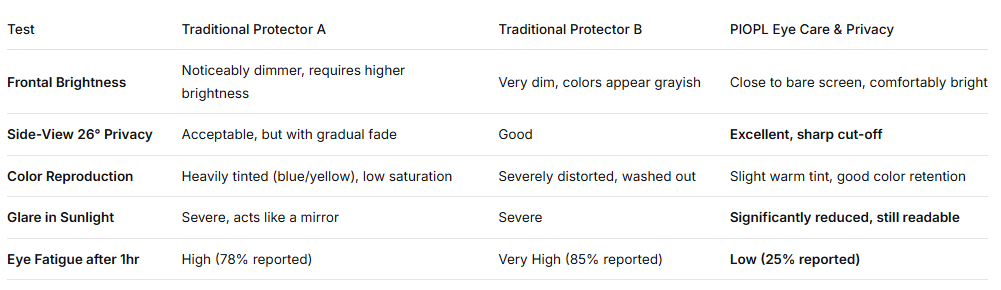
Chapter 5: Hands-On Comparison: PLOPL vs. Traditional Privacy Protectors
We compared PLOPL with three mainstream traditional privacy protectors:
Conclusion: From Compromise to Integration
The PLOPL Eye Care & Privacy Tempered Glass represents not a simple stacking of technologies, but a deep understanding of user pain points and a systematic solution. Through precise materials engineering and optical design, it shatters the industry curse that "privacy must harm your eyes," merging two previously conflicting needs into one harmonious user experience.
In an age where privacy is increasingly precious, protecting your on-screen information should not come at the cost of your visual health or viewing pleasure. Now, you can confidently have both.


