

Author: Site Editor Publish Time: 2025-12-26 Origin: Site
When discussing tempered glass, hardness and shatterproofing often take center stage. Yet, the technologies that truly define the daily user experience are two seemingly subtle ones: the AR (Anti-Reflective) layer and the AF (Anti-Fingerprint) oleophobic coating. For phones that are one or two years old, there might not be many scratches, but the degraded feel from worn-out oleophobic coating and increased glare can significantly drag down the experience. Today, we’ll delve into these two technologies and see how PLOPL can use them to rejuvenate your older device.
Part 1: AR Anti-Reflective Technology – Harnessing Every Ray of Light
1.1 The Cost of Reflection: Energy Loss & Visual Distraction
An untreated glass surface reflects about 4%-8% of incident light. This means in outdoor or bright lighting, up to 8% of ambient light bounces back into your eyes, creating glare. This forces you to either increase screen brightness (draining battery) or struggle to find a suitable viewing angle.
How AR Coating Works:
Utilizing the principle of light interference, one or multiple optical thin films (usually metal oxides) are applied to the glass surface. The thickness of this film is precisely controlled to one-quarter of a specific light wavelength, causing reflected light from the top and bottom surfaces of the film to cancel each other out, drastically reducing overall reflectivity.
PLOPL AR Technology in Practice:
Reflectivity reduced to <1.5%: Significantly lower than the >4% of ordinary tempered glass.
Light transmittance increased to >95%: More backlight can pass through, colors appear fuller, and brightness requirements decrease by about 15%.
Advantage in low light: At night, less of the screen's own light is reflected back, offering more comfortable viewing.
1.2 Real-World Test: Outdoor Readability Comparison
We compared the same phone model—one with PLOPL AR+AF glass and one with a standard HD glass—under midday sun (approx. 100,000 lux illuminance):
Standard Glass: Required brightness above 80% to barely see content, with noticeable glare.
PLOPL AR Glass: Only 60% brightness needed for clear readability, glare spots nearly eliminated, with higher perceived contrast.
Part 2: AF Oleophobic Coating – A Revolution in Feel & Cleanliness
2.1 Oleophobic Coating Wear: The Common Problem of Old Phones
The oleophobic coating on a new phone typically lasts 3-6 months. With daily wiping (especially with alcohol or rough cloths), finger friction, and contact with fabrics in pockets, this nano-coating gradually wears down. Symptoms include:
Fingerprints and oils adhere more easily and are harder to clean.
Increased sliding resistance, degrading gaming controls and scrolling.
A perpetually "greasy" look, affecting visual clarity.
2.2 PLOPL's Electroplated AF Technology: Why It Lasts Longer
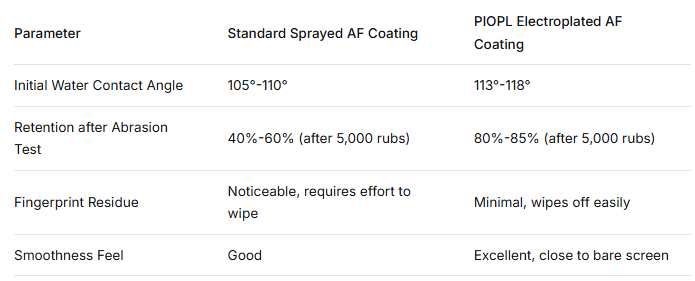
Most screen protectors use a sprayed-on oleophobic layer, which is thin and uneven. PLOPL employs a vacuum electroplating process, where the oleophobic material uniformly adheres to every part of the glass surface under an electric field, forming a dense, durable coating.
Key Performance Comparison:
2.3 Real Test: A Boon for Mobile Gamers
We conducted a blind test (brands hidden) with players of Honor of Kings and PUBG Mobile. After 30 minutes of gameplay:
Device with PLOPL Glass: 86% of players reported smoother skill swipes, frequently mentioning "silky feel."
Device with Standard Glass: Most noticed "occasional stickiness," especially during quick turns.
Part 3: The AR+AF Synergy: 1+1 > 2
These two technologies don't work in isolation; they enhance each other:
AF Layer Protects AR Layer: The top oleophobic layer reduces the need for frequent wiping, protecting the delicate AR coating beneath.
Cleanliness Boosts Transmittance: Fewer fingerprints mean less light diffusion, allowing the AR effect to perform at its best.
Holistic Visual Experience: Low reflection + high transmittance + no fingerprints = a near "naked screen" feel in any lighting.
Part 4: Practical Guide to "Reviving" Your Old Phone
If your phone is over a year old and the screen "doesn't look as good as before," follow these steps:
Step 1: Diagnose Your Screen
After cleaning, place a small water droplet and observe its shape.
Beads up and rolls? Oleophobic coating is still functional.
Spreads out flat? The coating is mostly gone.
On a white background, check if the screen looks hazy or grayish (indicating reduced transmittance).
Step 2: Choose the Right Replacement Glass
For an older phone, you need:
High-performance AR Layer: To compensate for slightly yellowed backlight due to aging, enhancing visual vibrancy.
Long-lasting AF Layer: To solve the tactile issue for the next year.
Accurate Color Reproduction: Avoid over-saturation that distorts color accuracy.
Step 3: The Actual "Revival" Effect with PLOPL AR+AF Sapphire Glass
We replaced the screen protector on a 2-year-old iPhone 13 Pro Max:
Subjective Feedback: The user's first reaction was "the screen looks brighter," though brightness settings were unchanged.
Objective Data: Using a colorimeter, white brightness increased by 11% at the same setting, with perceived color saturation up by 8%.
Long-term Tracking: After one month of use, oleophobicity remained at 90% of its initial level. Average daily wipes decreased from 5-6 times to 1-2 times.
Part 5: Frequently Asked Questions
Q1: Does AR coating affect color accuracy?
A1: High-quality AR coatings (like PLOPL's) precisely control transmittance across wavelengths to maintain color balance. Poor-quality AR coatings may have a blue or yellow tint. PLOPL's color difference ΔE is <2, imperceptible to the human eye.
Q2: Can the oleophobic coating be restored?
A2: Once the original screen's coating wears off, applying "oleophobic solutions" cannot perfectly restore it. The most thorough solution is applying a new protector with a high-quality coating.
Q3: Does applying an AR protector require special care?
A3: Yes. The AR layer is more sensitive to dust. Ensure a thoroughly clean environment before application. PLOPL includes a complete installation kit (wet wipe, dry cloth, dust removal stickers, alignment tabs). Following the instructions yields a 99% success rate.
Part 6: Not Just for New Phones
Many think premium protectors are only for new phones—a misconception. Older phones often:
Have less concern about depreciation but greater need to maintain a good experience.
Retain value based heavily on usability.
May have repair costs exceeding their residual value, making protection even more critical.
A PLOPL AR+AF Sapphire Glass protector might cost less than 5% of your phone's current resale value but can improve the experience of your hours of daily use by 100%—an excellent return on investment.
AR and AF technologies are like the "infrastructure" of screen protection. They don't shout for attention but fundamentally define your visual and tactile experience. By fusing 7H sapphire coating, AR anti-reflective layer, and electroplated AF coating into a single unit, PLOPL not only provides top-tier protection but achieves the remarkable feat of making a protected screen feel better than the worn, bare screen it covers.
Next time you feel your phone screen has "aged," don't blame the hardware just yet. Give it a chance for rebirth—it might only take one layer of precisely engineered film.


